Saturday, May 5, 2012

5. Becoming a Job-- or a Christ

Let us turn now to the process of Lear's transformation, one that may give us clues toward identifying our own. At the same time I want to keep up the parallel perspective, envisaging the process in Judeo-Christian and Gnostic terms.

In the storm Lear is obsessed with his double-dealing daughters. Even when he addresses the storm, his thought is that it owes him nothing, unlike his daughters. Yet there are some shifts. For the first time, Lear knows the Fool as a suffering human being:
Lear. [to Fool]  How dost my boy? Art cold?
I am cold myself.
(III.ii.68-69)
Then he becomes aware that this situation is one that happens to many others, those who up to now have been in his background, the homeless wanderers on the roads and in the towns, for whom he has not given a thought before. Now that he is one of them, he can see them as people. He stays outside long enough to extend his new-found compassion to them:
Lear. Poor, naked wretches, whereso'er you are,
That bide the pelting of this pitiless storm,
How shall your houseless heads and unfed sides,
Your looped and windowed raggedness, defend you
From seasons such as these? O, I have ta'en
Too little care of this! Take physic [medicine], pomp [ruler];
Expose thyself to feel what wretches feel,
That thou mayst shake the superflux [excess] to them,
And show the heavens more just.
(III.iv.28-36)
He is not only aware of these homeless ones, he recognizes the obligation of rulers to send some of what the rich do not need to help their misery. Gloucester comes to a similar realization after his own disaster: "So distribution should undo excess,/And each man have enough" (IV.i.73-74) Through their own experience, both men learn compassion.

This priming of Lear's compassion readies him to take advantage of what comes next. The hovel has an occupant already, who comes out when disturbed by Kent and the Fool. He wears only a dirty blanket, calls himself "poor Tom," and raves about "the foul fiend" whom he sees everywhere. He looks like what today we would call a homeless mentally ill person.

"Tom" is actually Gloucester's first-born son Edgar, hiding from his father. Edgar is the victim of a plot by the father's illegitimate second son Edmund, who has forged a letter in his brother’s handwriting plotting the father’s death; thus the naive Gloucester believes that Edgar sought to kill him. Edgar's desolation and fear now is only half put on, for he has turned from being Gloucester's heir to being a disguised fugitive in a matter of hours.

Explicit reference to Christian images starts with Lear's reaction to seeing Tom--i.e. Edgar in disguise. Lear immediately projects his own desolation onto Tom. "Have his daughters brought him to this?" he asks in apparent seriousness. Lear himself has been on the verge of madness; now "Tom" is showing Lear his own path-to-be. Beholding this wretch Lear exclaims:
Lear. ...Is man no more than this? Consider him well. Thou ow'st the worm no silk, the beast no hide, the sheep no wool, the cat no perfume. Ha! here's three on's are sophisticated! Thou art the thing itself; unaccomodated man is no more but such a poor, bare forked animal as thou art. Off, off, you lendings! come, unbutton here. [Tearing off his clothes.]  (III.iv.107-114)
Man, who has dominion over all creatures, is himself naked before the elements, unlike the animals. The emphasis is on what man is in essence, stripping all that comes to him by way of his privileged station. Shaheen detects here a reference to Psalm 8:4: "What is man, that thou art mindful of him, and the son of man that thou visitest him?" The Psalmist is emphasizing man's exalted station "a little lower than God" (8:5, in the Geneva Bible of Shakespeare’s time; King James has "lower than the angels") vis a vis the animals over whom he has dominion. Paul quotes the Psalm at Heb. 2:6-7, applying it to Christ, who lowered himself to man's station "a little lower than the angels." Directors of the play sometimes have Edgar stand with outstretched arms during Lear's speech, to emphasize the parallel with Christ. Another Biblical verse I find reminiscent of this speech of Lear's is John 19:5, Pilate's "Behold the man"--"Ecce Homo" in Latin: Jesus alone, his fate in Pilate's hands. Edgar and Christ are indeed comparable here, for both appear to be heading for their deaths, persecuted by their people, dressed in rags, and stripped of their noble birth. This is an image that Lear, too, can readily identify with.

A short time later Gloucester comes in concerned for Lear's well-being. He does not recognize his son Edgar, but what he sees impresses him enough to say the next day:
Gloucester. I’the last night’s storm, I such a fellow saw
Which made me think a man a worm
. (IV.i.34-35)
"Worm" here is, according to Shaheen, a reference to Psalm 22:6, "I am a worm and no man, a shame of men and the contempt of the people." This is the dark Psalm that begins "My God, my God, why hast thou forsaken me?", Christ's words on the cross, and continues with "They pierced my hands and my feet" (22:16) and "They cast lots upon my vesture" (22:18)--lines held to be predictions of the Messiah's fate.

Sheehan also draws attention to the worm as an image in the book of Job. Job says, "I have said...to the worms, thou art my mother, and my sister" (Job 17:14). Another verse goes: “Behold, he [God] will give no light to the moon, and the stars are not pure in his sight. How much less man, that is a worm? and the son of man, which is a worm?” (Job 25:5-6). (I cite Verse 5 as it appears in the Geneva Bible, the translation that Shakespeare used. Here the word "give" suggests the same line of thought as the "owest" in Lear's earlier speech: Just as God has given the moon no light of its own, he has given man no hide, silk, or perfume. The parallel is lost in King James: "Behold even to the moon, and it shineth not.")

Whatever "son of man" means in Job, in the New Testament (Heb. 2:6), the reference is to Christ. The worm is another image for "unaccommodated man," small and miserable without all the things he has made, yet thereby capable of redemption. Job is one who becomes such a worm. Jesus, too, is such a worm, as we shall see shortly--but in Gnosticism, not orthodox Christianity, in which Jesus has no need of redemption.

Yet Job is one who rises up even above the God who tests him, as Jung argues in Answer to Job (1969b). Jung imagines God's experience of Job, the man he has had Satan deprive of everything--his wealth, his family, and his health--just to satisfy a bet. Job is even noble than God himself, God must be thinking; thus God resolves to be such a "worm" himself.

This image of man as a worm also appears in Gnosticism, most clearly Irenaeus’s summary of Saturninus, who preceded the Ophites. For him the world was created by seven angels, offspring of the most high. (This corresponds to the Hebrew wording in Genesis, which says that the world was created by Elohim, a plural form meaning “the gods,” but which in Genesis takes singular adjectives and pronouns). These angels saw an image on high and tried to create a being like that image. But the being “was unable to stand erect because of the angels’ impotence, and rather writhed on the ground like a worm” (Layton 1978, 167). The higher power, in whose likeness the being was made, takes pity on it and sends it a spark of spiritual power, which makes it rise up.

The Ophites, as summarized by Irenaeus, expand further on this myth:
They [the rulers] came together and they formed a human being who was immense in breadth and length. But since it could only writhe upon the ground, they carried it to their parent. But wisdom (Sophia) was causing this so that she might empty it (Ialdabaoth) of the secretion of light, so that it might not rise up against those that were above it by having power. And when it breathed a spirit of life into the human being—they say—it was inadvertently emptied of power. (Layton 1987, 176)
The creation of humanity is the means by which Sophia can take away what little power Ialdabaoth has, which he might use against those higher than he. In giving spirit to humanity, he loses that power. (The being’s size, I think, a reference to the Jewish doctrine of Adam Kadmon, the first human being, envisioned as a spiritual being of great size.) We have already seen what happens next: he pulls the light out in the form of Eve, from whom Sophia can easily remove it. Later she gives the light back to at least some of humanity, for it is in virtue of its possession that Sophia saves Noah (178). Possibly it came back in by way of Eve’s offspring Seth and Norea (178). For our purposes, what is important is that it is precisely humanity’s worm-like condition, its inability to rise on its own, that is the occasion for its receiving the light and rising up. The greatest poverty is the occasion for the greatest gift.

This spiritual attractiveness of the most naked position is what draws Lear to the disguised Edgar. It leads Lear to begin tearing off his clothes, making himself such an "unaccomodated man." Lear is himself willing to live the human essence, humanity stripped of all the protection with which its intelligence has learned to shield itself. (Earlier, with Regan, Lear had denounced precisely this humanity deprived of the superfluous: "Allow not nature more than nature needs/Man's life is cheap as beast's" (II.ii.455-456).) Lear has learned to raise himself up spiritually, just as Jung's Jehovah had exalted himself by becoming Christ on the cross. As though with these parallels in mind, the play adds disaster to disaster, as with Job and Jesus.

The Gospel of Thomas, another text from Nag Hammadi—this one perhaps earlier than the Gnostics, but used by them (De Conick 1996, 144f)--also uses the image of removing one's clothes, at Logion (Saying) 37:
His disciples said, "When will you become revealed to us and when shall we see you?" Jesus said, "When you disrobe without being ashamed and take up your garments and place them under your feet like little children and tread on them, then you will see the son of the living one and shall not be afraid." (Robinson 1988, 130)
The disciples will see Christ as he really is when they have separated themselves from the things of this world, including even the body. What is more, they must do this without shame, like “little children,” those who are naked without shame, as Adam and Eve were before they tasted the forbidden fruit, but in a new way (De Conick 1996, 144f). Then one is in the Kingdom of God. The mystic’s imaginal ascent to the divine, after the most rigorous and lengthy ascetic preparation, is one way in which this may be achieved (De Conick, 145). The crucified Christ is another. Lear's gesture of removing his clothes, emulating Edgar, continues the divestment that started when he gave away his lands. It represents the inner process of stripping off the world, that the spirit might manifest. He is approaching the "nothing" which Cordelia first mentioned, the “beginner’s mind” to which the Zen initiate aspires.

The Gospel of Truth takes Lear's image of disrobing further:
Jesus appeared. He was nailed to the cross; he published the edict of the Father on the cross. O such great teaching! He draws himself down to death though life eternal clothes him. Having stripped himself of the perishable rags, he put on imperishability, which no one can possibly take away from him. (Robinson 1988, 42).
Jesus became naked without shame, and then put on other clothing, imperishability. Just so, Lear's suffering is the road to his salvation, not only to self-knowledge but to contact with a divinity superior to his ego, a divinity within that makes him part of that divine world even while on earth. In this process Ego itself partly dissolves, in moments of madness. The result, when Ego has returned but with a new connection to Self, is near the end, when Cordelia and he are captured by the sisters' victorious forces. Cordelia despairs, but Lear is joyful: they will be "Gods spies" [sic] in prison, taking upon themselves "the mystery of things" (V.iii.17). I will discuss this scene in more detail later. Lear is not simply excited about being reunited with Cordelia; he has had a transformation for which the play has been gradually preparing us, through the Fool.

6. Sweet and bitter fools and fruits

The Fool has hinted at Lear's redemption in two early jokes. The references are not very clear, but an audience accustomed to Biblical allusions would have picked them up: "Dost thou know the difference between a sweet fool and a bitter one?" the Fool asks Lear, early on while they are still at Goneril's. When Lear fails to see what is coming, the Fool makes up a rhyme:
Fool. That lord that counselled thee to give away thy land,
Come place him here by me; do thou for him stand.
The sweet and bitter fool will presently appear,
The one in motley here, the other found out there.
(I.iv.137-140)
"Dost thou call me fool, boy?" asks Lear, getting the point, or at least part of it. The contrast between sweet and bitter slid by without our noticing its reference. Historically these adjectives were applied to the fruit of two trees, the tree of knowledge in the Garden of Eden and the cross upon which Christ is crucified, a kind of metaphorical tree. It is spoken of as such in Acts 10:39, where Peter says Jesus is the one "whom they slew and hanged on a tree." The metaphor suggests a contrast with the Tree of Knowledge, whereby the first parents committed the sin now being redeemed. A popular medieval romance, the Golden Legend, even identified the two trees, saying that the wood of the tree of knowledge became the wood of the cross. In the Renaissance this story was the subject of a famous fresco cycle by the Italian painter Piero della Francesca.

The point is, first, that the fruit of the tree in the Garden is "bitter fruit," because of its result, Adam and Eve's expulsion from the Garden and humanity’s life of woe ever since. Second, Christ on the cross is "sweet fruit," because eating that fruit, accepting Christ, gives eternal life.

A medieval example of the contrast, and the identification of the trees, is in a hymn by Cardenal. We shall see shortly how this hymn amplifies the Fool's words and indicates Lear's process:
This fact was miraculous,                                Aquest fagz fo meravilhos,
That on that wood where                                Qu’el leinh on pres
                     death had its birth                                            mortz naissemen,   
There was for us both life and forgiveness,   Nos nasquet vida e perdos,
And rest in place of torment.                          E repaus en loc de tormen.
On the cross everyone                                   En crotz pot trobar veramen
Who deigns to seek may find                         Totz homs, que querre l’i denha,
The fruit of the tree of knowledge.                Lo frug del albre de saber.   

…Christ died on the cross for us,                 Cristz mori en la crotz per nos,       
And dying, destroyed our death;                   E destruis nostra mort, moren;
And on the cross he vanquished                   E en crotz venset                        
the proud one,                                                 l’ergulhos,
On that wood where he used to vanquish men.    El leinh on vensia la gen.
And on the cross he wrought salvation;        Et en crotz obret salvamen,
On the cross He reigned and does reign,     Et en crotz renhet e renha,
And on the cross went to redeem us.            Et en crotz nos volc rezemer.

He culls the sweet fruit who                              Lo dous frug cuelh qui              
takes the cross                                                    la crotz pren                               And follows Christ to wherever he may lead,   E sec Crist vas on que tenha,
For Christ is the fruit of knowledge.                Que Cristz es lo frugz de saber.

(Press 1971, 303-305)
In the first stanza, the phrase "rest in place of torment" describes what we get when we find that "kingdom of God" within. It is also the "sweet fruit" described in the last stanza. It is a this-life rest unaffected by accidents of fortune, including torture and death, by which one is no longer a "fool of fortune" (IV.vi.195). It contrasts with the bitter fruit of suffering and death that resulted from the tree in Eden. At the same time the "sweet fruit" is Christ himself, for "the fruit of the tree of knowledge" is "on the cross." Christ and "rest" are the same.

Next, both fruits come from the same tree, as in the Golden Legend. The first stanza is clear on this point: "On that wood where death had been born was born for us both life and forgiveness." The second stanza repeats the point: The tree where "the proud one" defeated humanity, in the persons of Adam and Eve, is also, as the cross, the tree that defeats that "proud one."

The phrase "the proud one" (“l’ergolus”) is ambiguous, given the time and place in which Cardenal was writing. In orthodox Christianity that phrase would mean the personage inhabiting the snake which led Adam and Eve astray. But in Gnosticism, and the Catharism of Cardenal's time, it is the Lord in the story, Jehovah, whose pride was wounded by Adam and Eve's disobedience, and who in retaliation "vanquished men." It is Jehovah whose rule is defeated by the Christ whose "perishable rags" (Robinson 1988, 42) hang on the cross. Christ's teachings lead humanity to the God of All, of whom Jehovah was ignorant.

The serpent, on this latter reading, might be Jehovah’s accomplice but might also be innocent of wrongdoing, even be Christ, or Sophia, as the Gnostic texts had suggested. An early 17th century alchemical engraving and a late 16th century German coin (Fig. 26 and Fig.  27; Campbell 1968, 153) do suggest just such a possibility, showing a serpent on a cross just like that of Jesus.
Figure 26. Serpent on crosst, from "Nicholas Flammel," Exposition of the Hieroglyphicall Figures which he caused to bee paimted upon an arch in St. Innocents Church-Yard, in Paris, London 1624.

  
The conventional interpretation of the image in Fig. 26 is that Christ has undone the damage caused by the serpent. John 3:14 says, "And as Moses lifted up the serpent in the wilderness, even so must the Son of Man be lifted up." This verse compares Christ to the bronze serpent that Moses hung on a pole, that the Israelites might by seeing it magically be cured of the snake bites they had received for their lack of faith. Likewise Christ is lifted onto the cross to atone for Adam and Eve’s lack of faith in the Garden of Eden (Campbell 1968, 153-154). But meditation on the image might reveal another interpretation: perhaps Christ simply is the serpent of the garden, who gave liberating knowledge to Adam and Eve, after which Jehovah punished them.

 Figure. 27. The Serpent Lifted Up. Hieronymus Magedeburger, Golden Thaler, Germany late 16th century.


The last line of Cardenal's song can similarly be taken in two ways. Christ is the "fruit of knowledge" in the sense of being the outcome of the problem posed by the tree of knowledge in Eden. He could also be the "fruit of knowledge" in another sense, in which Christ as salvation comes from knowledge as opposed to faith. Salvation--the "sweet fruit"--is not in orthodox Christianity considered the result of knowledge--i.e. experience and thought--but rather something that may be acquired by belief and faith. Cardenal's words intimate something else, salvation by knowledge, gnosis, which the Cathars appear also to have experienced. (The Cathars did have their believers, credentes, but these, so long as they merely believed, could only look forward to a better reincarnation, one in which they would receive the saving knowledge.)

Cardenal's wording has much in common with a passage in the Gospel of Truth, if I may quote again from that papyrus that lay buried so long beneath uncultivated land in the Nile Valley. This passage is one that describes Christ and his significance:
He was nailed to a tree; he became a fruit of the knowledge of the Father, which did not, however, become destructive because it was eaten, but to those who ate it gave cause to become glad in the discovery. (Robinson 1988, 41)
Here, too, Christ is a “fruit of knowledge"--again, not merely of faith. As well, Christ is the sweet fruit, i.e. the fruit that makes the eater "glad." This fruit contrasts, implicitly, with the bitter fruit, i.e. the fruit that is "destructive" to the eater.
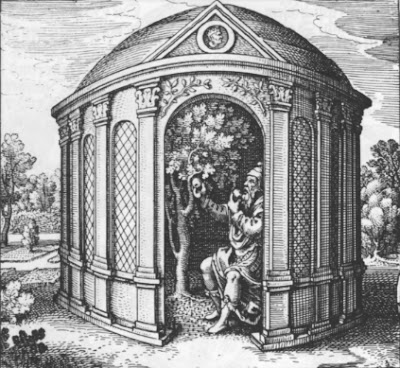
Figure 28, "Enclose the old man and the tree in a house of dew, and eating of its fruit he will be made young." Emblem 9 of Michael Maier, Atalanta Fugiens Oppenheim 1618.

In Maier's Atalanta Fugiens, one engraving in particular fits this discussion. An old man sits in an enclosure, grasping apples on a tree (Fig. 28 above; de Rola 1988, 75). The motto is "Lock the tree with the old man in a bedewed house, and by eating o the tree's fruit, the old man becomes young" (de Jong 1969, 100). The dew is that of the "living water," Mercury, which enters the fruit. As in the case of the sweat bath (Fig. 12), the enclosure serves to isolate the alchemist, just as the storm isolates Lear; it also serves to contain the moisture, resulting in a continual bath of falling dew, like the storm and the various characters' tears. 

Maier makes no comment on one noteworthy feature in the engraving. There are two fruits: one almost in the man's mouth, a second in his other hand but still on the tree. In keeping with Lear's process, we might imagine the man biting into a bitter fruit first, before the Mercury has had time to heat up and penetrate the fruit. The dew is then first the cold rain and Lear’s own and his elder daughters' bitter tears; this dew characterizes the first fruit. Then later, as the enclosure heats, the due is the warm vapors provided by Cordelia's physician and the tender, warm tears shed in the reunion; the dew is now a kind of purifying steam bath, and the fruit eaten then a sweet one. 

One application of the “fruit” image to the play is clear enough. Just as trees' fruit, when planted, are young trees, so people's fruit is their offspring, the "fruit of their loins." Lear ate bitter fruit in trusting his older daughters. His ignorance of what is truly sweet, as opposed to what appears sweet, is what makes him the "bitter fool," and the Fool, who knows better, the "sweet fool." Then Lear's very bitterness is the basis for new knowledge, by means of which later he recognizes the sweet fruit Cordelia.

In case the Fool's image did not stick in our peripheral consciousness the first time, the Fool has a second joke about sweet and bitter fruit, when Lear goes to visit Regan in hopes of a better reception than he got from Goneril:
Fool. Shalt see thy other daughter will use thee kindly; for though she's as like this as a crab's like an apple, yet I can tell what I can tell.
Lear. What canst tell, boy?
Fool. She will taste as like this as a crab [crab-apple, noted for its sourness] does to a crab.
(I.iv.14-18)
The Fool's prediction of kindliness is ironic. Regan is another bitter fruit that seems sweet. First, Regan is as like kindliness as a crab is like an apple, which is not much. Yet a crab is an apple, a crab-apple (as Foakes points out in his note in the 1997 Arden edition). Then Regan will taste as a crab-apple will taste to someone like Lear, a crabby person, for she is as crabby, i.e. sour, as he is: In Regan he will taste a bitter apple. Since the fruit of the Tree of Knowledge was conventionally represented in Renaissance art as apples, a fruit expected to be sweet, we have again a reference to the fruit of that tree, which appears sweet but tastes bitter.

The contrast between the bitter fool and the sweet one, Lear and his Fool, reflects another contrast. First there is the god of Genesis, whom the Gnostics call "fool," who expels the companions he created out of the beautiful garden he made for them, and remains continually disappointed, both in humanity as a whole and in whatever chosen people he finds there. In contrast to this bitter god is what Paul calls "the foolishness of God" (1 Cor. 1:25), which is "wiser than men," namely, "the preaching of Christ crucified" (1 Cor.1:23). This is the wisdom that does not care about the things of this world or the opinions of people attached to such things. It is a wisdom that the world calls foolishness.

Erasmus had famously contrasted this second type of foolishness to the first in his Praise of Folly: “The happiness which Christians seek with so many labours is nothing other than a certain kind of madness and folly” (1971, 202). As he observes, in his ironic style:
All mortals are fools, even the most pious. Christ too, though he is the wisdom of the Father, was made something of a fool himself in order to help the folly of mankind, when he assumed the nature of man and was seen in man’s form; just as he was made sin so that he could redeem sinners. Nor did he wish them to be redeemed in any other way save by the folly of the cross and through his simple, ignorant apostles, to whom he unfailingly preached folly. He taught them to shun wisdom, and made his appeal through the example of children, lilies, mustard-seed and humble sparrows, all foolish, senseless things, which live their lives by natural instinct alone, free from care or purpose. (1971, 199)
It is the foolish wisdom of Lear’s "unaccommodated man," who has taken off his worldly clothing, or of France’s description of Cordelia as "most rich being poor" (I.i.252).

In this regard the Fool of tarot deserves a closer look. The one we know, in bright Carnival-style harlequin clothes (Fig. 3, in section 2), was not on tarot cards until the late 17th century (Kaplan 1978). Tarot is first documented in 15th century Italy; its Italian name was first carta di trionfi, then tarocchi, which became tarot in French (Dummett 1986). In the 16th century the decks rapidly spread throughout Europe, including England (Kaplan 1978). Again, let me emphasize that the game was one like Bridge, not fortune-telling (Dummett 1986). Meaningful images were put on the cards as a help to the memory. Our reason for looking at the images is to get a better idea of how the figure was conceived at that time.

With that in mind, Let us turn to three documented 15th century versions of the Fool card, plus an artist’s reconstruction of what another one probably looked like (Figs. 29, 32, 34, 36). In all but one, what corresponds to the Fool is a beggar, dressed in rags and carrying a staff, as though for walking or self-defense. In relation to King Lear, the figure of Edgar comes to mind, dressed in rags, wandering the heath, yet capable of killing an adversary if need be, as in fact he does when attacked by Goneril’s steward Oswald. In modern Sicily the card is called il Fuggitivo, “the fugitive” (Dummett 1986), a name especially apt for Edgar (but we do not know if this name goes back to Shakespeare’s time).

Figure 29, right, PMB Fool card, 1450s Milan.. Figure 32, center, "Tarot of Mantegna" Misero card, c. 1565 northern Italy. Figure 30, right, Giotto "Stultitia" fresco, Padua .Scovegni Chapel  c. 1305..

The earliest clearly datable card (Fig. 29; Ennis 1987, 63) is from the so-called Pierpont Morgan-Bergamo (PMB) deck, from around 1440-1460 in Milan, done for the Visconti-Sforza ruling family of Milan. He was called the Matto, Madman. The figure is a thin beggar with his leggings falling around his ankles. Six feathers are visible sticking out of his head. As tarot scholars have observed, the figure resembles an allegorical figure representing folly, done as part of a famous fresco cycle by the painter Giotto in1302-1305 (Fig. 30; von der Haegen 1998, 52). Giotto’s figure appears to be blessing a crowd, using a gesture normally reserved for the Pope—or for Christ in religious representations (e.g. Christ entering Jerusalem, in the same fresco cycle, Fig. 31; von der Haegen 1998, 67)). He is a figure from traditional Carnival celebrations. A beggar was elected “King” or “Pope” and treated with mock dignity throughout. He wore seven feathers, one for each week of Lent. After Carnival, many people of all walks of life would wear similar simple white clothing as part of their Lenten observance (Kaplan 1978).  
Figure 31. Christ entering Jerusalem. Detail of fresco by Giotto, Padua Scovegna Chapel c. 1305..

Another early card that has survived is not from tarot as such, but from a set of fifty cards that illustrated the “ten conditions of man,” the nine muses plus Apollo, the ten liberal arts, the “ten cosmic conditions,” and the “ten firmaments of the universe.” The deck is called the “Tarocchi of Montegna” and is in the style of Ferrara, Italy, around 1465 (Levenson et al 1973). (Andrea Montegna was a famous painter in Mantua at that time, but his style was quite different.) There are distinct correspondences between the images in this deck and those of tarot, including the first card, showing the lowest condition of man, the beggar (Fig. 32; Innes 1987, 63).  Captioned “Misero,” or misery, the figure leans on his staff half-dressed. Here something new has been added: A dog jumps onto his leg and another one sits in front of him. The stick would be useful for warding off the jumping dog, but he does not use it. He seems not to notice them. One leg appears to have a scrape on it, as though from a previous attack. Since dogs usually attack strangers, the implication would seem to be that he wanders dejectedly from place to place.
 Figure 33. So-called "Chosson" Fool card, late 17th or early 18th century Marseille.

This latter aspect, the jumping dog, continued in numerous tarot decks to come. For example (Fig. 33; from http://tarotchoco.quebecblogue.com/arcanes-majeurs-photos-tarot-de-francois-chosson/ ), in the “Tarot of Marseille,” this image of late 17th or early early 18th century Marseille, the Fool is dressed in his customary motley colors, but still has the dog jumping at him, at either a purse or a bare spot on his leg, where the scrape had been on the “Montegna” card. is image may be as early as c. 1500.
 
Figure 34. left, "Griggonneur"/"Charles VI" Fool card, Florence c. 1460.and Fig. 35, center, "Mantegna" Saturn card, c. 1465 northern Italy. Fig. 4 repeated is at right, from Holbein's illustrations to Erasmus's Praise of Folly 1515.

The third existing card (Fig. 34, above left; Innes 1987, 65) is from the so-called “Gringonneur”or "Charles VI" pack, allegedly from 1392 but now placed at c. 1460 Florence. It is of a giant playing with an oversized string of beads or medallions, with four small figures gathering stones around its legs. According to Innes (1987), the giant resembles the huge figures paraded about at Carnival. However I think we can say more. The image of a giant with four figures underfoot occurs also in the “Montegna” deck—it is Saturn, shown there bringing a fifth small figure to his mouth; he also holds a serpent biting its tail and a scythe (Fig. 35 above right; Innes, 35). As I see it, the “Gringonneur” Fool is a Saturn who is so busy eating one child he does not watch out for the others, who like David before Goliath can bring a giant down using mere stones. The chain that the Fool is playing with is identifiable from Fig. 4 (from section 2), where a foolish king wears a similar chain across his upper chest. The “Gringonneur” image thus suggests a dictatorial ruler who thinks he is too powerful to worry about usurpers. Both the “Gringonneur” and “Montegna” images fit Lear precisely.

The earliest image of the Fool in his characteristic mode of walking with a stick over his shoulder is in the so-called Cary Sheet, c. 1500. It is on the right below, Fig. 36, with that deck's Magician card, then called the "Bagatella", or "trivial performer," on the left.

Figure 36 (fragment on right). Cary Sheet Fool card, c. 1500, probably Milan.

There is an interesting theory about the Fool as wandering beggar (Kaplan 1986). The man could have been seen as a wandering heretic, from any of several sects, traveling secretly from village to village ministering to his flock. The Cathars had been the most numerous; a few had been rooted out of the Piedmont hills even in the late 14th century. The attacking dog suggests that the man is a stranger, as indeed the Cathars preached that humanity is on earth, subject to continual attack by agents of the “alien god.” What most suggests heresy is the dog, not seen in the Cary Sheet, but evident as early as the "Tarot of Mantegna" of c. 1465. It is an image that became associated with the Dominican Inquisition, which was called “the dogs of God,” Domini canes in Latin, a pun on the name of the order. They had themselves portrayed in art (in the Church of Maria Novella in Florence0 as dogs tearing the flesh from wolves that raided their flocks. The message from this perspective is that the heretics and those who follow them are fools, for they sacrifice everything, including not only their goods and families but their very lives, burning at the stake, and then suffer eternally in Hell for their pains. Against this story, it must be said that  there were many such beggars, including Franciscans and Domnicans as well as the homeless mentally ill, which is how "Tom"--Edgar in disguise--portrays himself in Lear.

Ironically, however, that same figure is a fitting image for Christ, who also met an ignominious death at the hands of the authorities. He, too, possessed nothing, and risked his life traveling from village to village preaching his deviation from orthodoxy. From this perspective, the six feathers radiate out from the Fool’s head like a halo or a crown. Christ, of course, had his crown of thorns as “King of the Jews.” Giotto’s Folly was also a King, King of the Beggars, who reminded people at Carnival of the Lenten austerities to come. Giotto did his frescoes in the city of Padua, a mere 100 miles from where 200 Cathars had been burned en mass in 1278.

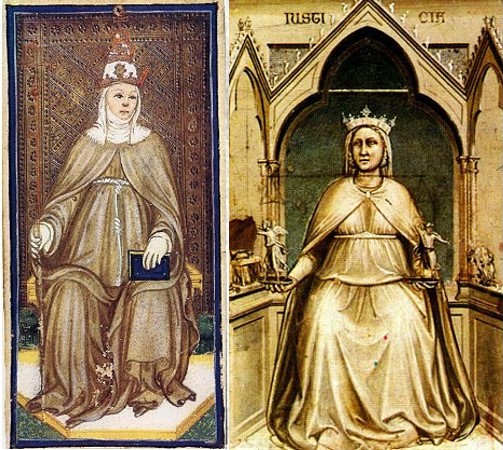
Other associations with heresy appear elsewhere in early tarot. The PMB deck, the one with the thin beggar having six feathers but no dog, has a card called the “Popess,” the lady Pope (Fig. 37; Innes 1987, 21). According to Moakley and others, she isdressed in the habit of the Guglielmites, a heretical order of nuns that held that in the future women would be popes (Kaplan 1978). A relative of the Visconti family, Sister Manfreda, reportedly was elected Pope by the order and burned by the Inquisition in 1300 (Innes 1987).
Figure 37, left, PMB Popess card, 1450s Milan. Figure 38, right, Giotto, fresco of Justice, Padua c. 1305.
 
Fittingly, the Popess card bears a resemblance to Giotto’s figure of Justice (Fig. 38, von der Haegen 1998, 51; it also bears a resemblance to Giotto's figure of Faith); I detect as well a resemblance of Giotto's Injustice (Fig. 39; von der Haegen 1998, 52).  to Giotto’s Injustice (Fig. 40, Innes 1987, 26)
Figure 39, left, Giotto, Injustice fresco, Scovegni Chapel, Padua c. 1305  Figure 40, right, PMB Pope card, 1450s Milan.

Giotto’s figures certainly resemble these two cards more than they do any other cards, including ones named “justice,” “emperor” and “empress.” One might wonder whether Giotto’s figures, and the tarocchi cards that followed them, belie a sense that the woman pope is on the side of justice, while the male pope that promoted her death is on the side of injustice. Giotto did his frescoes a mere 100 miles from Verona, where the nun was burned, and less than five years after. After that, the Inquisition investigated the Lord of Milan himself, an earlier Visconti, for heretical connections, an action that would not have endeared the papacy to his successors.

I do not know whether Shakespeare was familiar with tarot, or with these images. We know only that tarot had spread to England by the 16th century. Even without tarot, the image of a wandering beggar being snapped at by dogs was common enough, in life as well as art (Dixon 2000, Ch. 3)—although perhaps not the association with heresy. But I do notice a loose parallel between Shakespeare’s play The Tempest and the Visconti-Sforza dynasty which sponsored the early decks. In 14th century Milan, power was shared by two Visconti brothers. One was quiet and reserved, while the other was the real ruler, both lusty and ruthless (Kaplan 1978). This contrast resembles that between the two brothers Prospero, Duke of Milan in the play, and Antonio, his usurper brother, in The Tempest. Filippo Visconti, for whom the earliest tarot decks on record were made, was the second son of a later Duke; he attained his position in 1412 after his older brother was assassinated. In Shakespeare’s play, the older brother Prospero is merely exiled when the younger seizes power. Filippo had an illegitimate daughter named Bianca whom he married to his most valued protégé, the commoner Francesco Sforza, son of the man who defied the Pope. The marriage was a happy one, and Sforza successfully established himself as Duke after his father-in-law’s death. These events loosely parallel Prospero’s daughter Miranda’s marrying the stalwart Ferdinand, who presumably will become Duke of Milan after Prospero’s death.

7. The way of the fool

What is the teaching of the Fool, as sacred jester? Paul in 1 Corinthians says that Christ’s message is not to care for the things of this world. But how to get such detachment? What is the Way of the Fool. The Fool teaches us playfulness about our lot in life. Paul, despite his praise of the fool, seems too serious to be our teacher here. Closer to the Fool is an ancient heretical Jesus, the playful Jesus of the apocryphal Acts of John, in a part that scholars have identified as Gnostic or proto-Gnostic in content (Pulver 1955). Although both Rome and Constantinope had tried to destroy every copy, it was preserved by the Coptic Church in Egypt and made available to scholars in the 19th century.

Like other Gnostic texts, the Acts of John distinguishes two gods. One is “a serpent outside the law,” who gave the Jews who had Jesus arrested their law (Pulver 1955, 178). I am reminded here of the “Ophite diagram,” with its tail-eating snake ringing the planets. The other god is the Father, who Jesus also is: “I am thy God,” he tells the disciples, “not the betrayer’s God” (179). The text tells how Jesus, on the eve of his crucifixion, does a song and dance routine for the dumbfounded disciples. The song, the so-called Hymn of Jesus, was quoted by Augustine in his 237th letter, for the purpose of denouncing it as an absurd fraud. This letter was readily accessible in Shakespeare’s day, and someone interested in heresy could easily have found it.

The setting for the Hymn is after the Last Supper, when Jesus is awaiting his arrest. He asks the anxious disciples to dance in a circle around him while he teaches them a new song; they are to say “amen” after each line that he sings. Matthew 26:30 and Mark 14:26 do mention some singing, but say only “And when they had sung a hymn, they went out into the Mount of Olives.” The Acts of John gives words to such a hymn:
I will be freed and I will free, Amen.
I will be saved and I will save, Amen.
(six similar lines, using "wound" "beget" "consume" "hear" and "know")
I will be washed and I will wash, Amen.
Grace paces the round. I will blow the pipes.
Dance the round all...
(Pulver 1955, 179)
The word that Pulver translates as “will,” actually means “intend to,” according to Hennecke and McWilson (1964) in their more recent translation. Augustine’s translator uses “wish”: “I wish to save,” etc. Mead (1903, 431ff) has “I would.”

The hymn has more, about various groups in the realm above--"the eight," "the twelve," "the All," dancing the round with them. The below affects the above, as consciousness affects the unconscious. Then there are three more “I will”’s: "I will flee," " I will adorn," and "I will unite," and the corresponding phrase in the passive voice.

Augustine quotes four of the “I will”’s—save, free, be born, and adorn. He says he knows how the “heretics” publicly interpret these verses: To say that one will be free, they say, is to say that the Lord has released us from the world that we may not become entangled in it again. To be saved is to be saved through baptism, and to save is to guard in us the spirit given us in baptism. To adorn, and be adorned, means that Christ may adorn our hearts. All of this is orthodox, he says, no different from the canonical teachings.

But Augustine adds that the “heretics” must have a secret interpretation as well, because otherwise why do they insist that the hymn imparts secret teaching? He does not speculate on what that teaching might be. Yet it seems to me that the unorthodoxy is right on the surface. For Jesus to say “I would be saved” now, long after his baptism, is to say that he, Jesus, is still in need of redemption, even after all his teachings and healings. The mere presence here of a redeemer needing to be redeemed is a departure from orthodoxy. Jesus as wholly God, for the orthodox, is himself in no need of redemption. The mystery unfolds in later sections of the story, in a later section that Augustine alludes to but does not talk about.

Next the Hymn speaks of the suffering that Jesus is to undergo, and its meaning for humanity:
If thou dancest, ponder what I do,
for thine is this human suffering that I will suffer...
If thou understoodest suffering
thou wouldst have nonsuffering.
See through suffering 
and thou wilt have nonsuffering...
And if thou wouldst understand that which is me, know this:
all that I have said, I have uttered playfully--
and I was by no means ashamed of it.

(Pulver 1955, 180; my arrangement into lines)
Of this Augustine quotes only the last two lines. Translated from Augustine’s Latin, these lines read: “By a word I made sport of all things and I am never made sport of.” (1956, 189). For his part, Augustine fumes at the very idea of a jesting Jesus. Augustine asks rhetorically “Where are we to go, to whom are we to give ear, in whose speech are we to have faith, in whose promise are we to put hope, if by a word Christ has made sport of all things?” (1956, 189). It is precisely this sentence, however, that would have appealed to someone like Shakespeare. It puts Christ in the same class as Lear’s Fool, someone who makes a jest out of everything yet speaks pure wisdom. It is also, of course, aligns Christ with the Fool of Tarot. This unorthodox Jesus, like Lear’s Fool, is no stranger to irony and humor. Later we shall look at the playful Lear.

Let us go back to the earlier part of the passage just quoted, on which Augustine was silent, in which Jesus expounds on suffering. Jesus says that the suffering he is to undergo is merely humanity's own suffering reflected back to it, role-modeled, so to speak, so as to be transcended.

How is that to be done? Translators differ on how to render the text. Pulver’s translation goes:
If thou understoodest suffering
thou wouldst have nonsuffering.
See through suffering 
and thou wilt have nonsuffering.
Other translators (most recently Bowe 1999) render these words differently:

If you learned how to suffer
You would have nonsuffering.
Learn how to suffer
And you will have nonsuffering.


Literally, the Greek reads, “If thou learned suffering” and “Learn suffering.” Pulver’s translation suggests a kind of rational insight into one’s suffering, so that we can come to terms with it. This sense is also implied by Jesus’s Biblical epithet “Logos,” meaning “word,” or “reason,” as in putting into words, becoming conscious, grasping the reason. What can we learn from suffering? we ask. It may be a matter of learning from our mistakes or a mistaken attitude, as Lear does, and living more wisely and fully. The other translation suggests some other process, such as laughing at our suffering, or singing and dancing about it (as the von Trier film “Dancing in the Dark.” also shows us.) Such a process is what Hindus call a “yoga,” a discipline: focusing on one’s breathing, for example. Such activity helps us to realize: I am not my suffering, I am more than that. Both senses, insight and adding another activity, help one to detach from the immediacy of suffering and transcend it.

Suffering is what Adam and Eve begin in leaving the Garden of Eden, in living by the sweat of their brow. Suffering is what Job does, losing all that he has, and now Jesus. Like Lear from Edgar, we learn from their example and try to understand, gain insight. Not all suffering leads to self-knowledge. Humans have a great capacity to repeat their suffering endlessly without getting outside it. Hence the need to understand. Lear sees his former arrogance as that which led to his suffering. That is part of understanding: learning to live better.

Another part, exemplified in the play first by the symbolism of Lear’s trying to disrobe, and now more directly his banter with Gloucester, is learning how to detach from life's seriousness. Jesus recommends in the Acts of John that the disciples think playfully, be playful and not be ashamed of it, as we might if we thought it were childish or undignified. Children are our model, in fact. Part of what is needed is to get rid of the dignity, or really pride, that would judge negatively a playfulness about one's projects. Jesus's play is his singing and dancing on the eve of his crucifixion, which the Church found too undignified and confusing to be worthy of including in the record, as though it undermined the significance of his suffering the next day.

I think now we can see one way in which Jesus is in need of redemption, freeing, birth, washing, being consumed. He has taken on “perishable rags,” as the Gospel of Truth puts it, i.e. materiality, for the purpose of showing humanity the way out of their situation. Humanity, likewise, is spirit imbedded in matter. Now he is in matter to show humanity the way.
A torch am I to thee who perceivest me, Amen.
A mirror am I to thee who discernist me, Amen.
A door am I to thee who knockest at me, Amen.
A way am I to thee who passest.
(Pulver 1955, 179)
We are reminded of the fool’s mirror, in Holbein’s illustration to Erasmus (Fig. 2, in section 2 of this essay), and Hamlet’s mirror, the actors. The phrase “who passest” is sometimes translated as “a wayfarer”; Jesus would have the disciples pass through life without attachments, as pictured by the tarot Fool. The way Jesus shows is through suffering, when it leads to detachment from suffering and detachment from the world. The crucifixion is simply a dramatic example, a mirror for humanity to see itself. In this sense, his redemption is humanity’s, as revealed by his suffering on the cross.

The hymn puts the crucifixion, and all human suffering, in the form of a short drama, a kind of play that can be repeated by the disciples and their disciples. Thereby it is itself a way of detaching from suffering: if one can play-act suffering, then one is something other than the suffering one; thereby one detaches from suffering. It is another way of “making sport” of “all things” without being made sport of, or of being ashamed of what one does.

The Hymn is over. But there is another section, which Augustine only refers to briefly and does not quote. In it Jesus speaks again, commenting further on the crucifixion. This part was read and condemned by the second Nicean Council of 787, which said, “No one is to copy (this book): not only so, but we consider that it deserves to be consigned to the fire” (Hennecke 1964, 193). Fortunately some of it was preserved in the Acts of the Council. (Fortunately, too, the whole text was preserved in one manuscript found in 19th century Vienna [Hennecke 202f].)

During the crucifixion, this part relates, the terrified John runs from the scene and hides in a cave on the Mount of Olives. Augustine stops there: He objects: how could this be true, when we know from the Gospel of John that he stayed below? But the text as we have it goes on: In the cave John sees a cross of light, along with a voice that sounds like that of Jesus, only sweeter. Jesus tells John to "have no concern for the many" (Pulver 1955, 182) who see him as the one on the cross of wood. It is his humanity that is on the cross: "Thine is this human suffering that I will suffer" (181). Jesus in his divine state is there in that cave, on the cross of light:
It [the light-cross] is not that cross, the wooden cross which thou wilt see when thou goest down thither. Nor am I he upon the stake, whom thou canst not see now, but whose voice alone thou perceivest. I passed for that which I am not, for what I was to the many others. What they will say of me is wretched and unworthy of me. Those who neither see nor name the place of stillness will much less see the Lord. (Pulver 1955, 181-182)
Jesus gives a suggestion of what he is through a series of paradoxical utterances: "A suffering one was I and one who suffered not/ Blood flowed from me yet it did not flow" (182) and so on. He is still playing with John, making sport, yet with a serious point. He has two natures, human and divine; one suffers, and thereby instructs; the other instructs verbally and suffers in a different sense. The spiritual Jesus goes on to say that he suffers incompleteness, a kind of amputation of his spiritual body; his “members” are in humanity, they are his “blood,” and he will not “be what I am” until all have come unto him. They are the “sparks of light,” in Irenaeus’s summary of the Gnostics (Barnstone 2984, 655), which overflowed their spiritual container and fell into matter. In returning home they also redeem him: Humanity redeems him as much as he redeems humanity. In fact, since they are part of his body, they and he are one (Lalleman 1998, 193ff). The “I” of the hymn now includes the disciples and all the sparks of light, as parts of himself that have become detached from him and attached to matter. When the disciples detach from their human suffering, and enter “the place of stillness,” they will be rejoining his spiritual body.

I do not think that King Lear goes so far as to illustrate such a view of redemption, as Jesus’s own completion. Shakespeare is more concerned with humanity than he is with God. For him what matters is the teaching that would have the bitter fool and those like him understand their suffering, play with it, speak of it in paradoxes, detach from it, and so become sweet, as the Fool is sweet. When Lear takes up the Fool’s playfulness in the midst of his suffering, it is as though he were following the lead of a playful Christ: and thereby it is not only play but redemption.

Lear embodies the bitter fool when he distributes his land and then sees his elder daughters refusing to live up to his expectations. Later he becomes the second, the sweet fool of play, in the hut during the storm. There he conducts a mock-trial of Goneril and Regan, with Tom as "Thou robed man of justice" (III.vi.21), and the Fool as “his yoke-fellow of equity” (III.vi.36-37), i.e. his fellow judge. When Lear addresses the mock-Goneril, the fool exclaims, “Cry you mercy, I took you for a joint-stool” (III.vi.51). As for the mock-Regan, the Olivier film has Lear holding a chicken as he speaks to her; when it gets away, he says, "Stop her there!" and "False justicer, why hast thou let her ''scape?" (III.vi.53-55).

Such activity and commentary tell us that Lear is not merely hallucinating. His activity is more akin to the Gestalt Therapy of Fritz Perls, a staple of which is addressing an empty chair containing an absent but significant other. As with Hamlet, it is not always clear when Lear is mad and when he is playing. This ambiguous playfulness, we shall see in the next section, continues the next morning with Gloucester, Edgar, and the soldiers, with whom he jokes and plays on the heath, even about quite serious things.

Shakespeare suggests the Hymn’s point about playfulness obliquely in a remark that Edgar makes to himself after the storm, on the heath near Gloucester's castle:
Edgar.                 ...To be worst,
The lowest and most dejected thing of fortune,
Stands still in esperance [hope], lives not in fear.
The lamentable change is from the best;
The worst returns to laughter...
(IV.i.2-6)
The usual interpretation of the last line (Foakes' note, Arden edition) is by the saying, "When things are at the worst, they will mend." The laughter is the joy of improved conditions, once we have hit bottom. For Edgar, unfortunately, things become worse yet, seventeen lines later, when his father tells him (without knowing that it is his son) that he was made blind.

But there is another way of taking "the worst returns to laughter," along the lines of Lear's process: If we can endure being the lowest without fear, we can also laugh at our worldly attachments. This interpretation connects with Jesus’s remark at the end of his Hymn, that he says everything in sport or play.. It also connects with what Edgar says three lines later, when he sees his father approaching on the heath, led by an old man:
Edgar.             ...But who comes here?
My father, poorly led? World, world, O world!
But that thy strange mutations make us hate thee,
Life would not yield to age.
(IV.i.9-12)
If we are too attached to life, we will resist death too strongly. Laughing at and despising our attachment to the world will ease the transition. In this context, detachment from suffering means not just from the moment of suffering but from life as a whole.

Yet the goal of life is not simply to be ready to leave it. That would be Hamlet's "The readiness is all" (Ham.IV). Gloucester is all too ready to leave this life; he is in such despair that he says:
Glou. As flies to wanton boys are we to the gods;
They kill us for their sport. (IV.1.38-39)
He has even solicited Edgar to lead him to the cliffs of Dover, so that he may commit suicide. Edgar leads him to a small mound where he may jump off. Edgar is playing with his father. The trick works, and he is not sad for a while. But the urge returns. In reply to his father’s despair, Edgar gives this play’s equivalent of Hamlet’s bon mot, continuing the Fool’s fruit metaphor:
Edgar. What, in ill thoughts again? Men must endure
Their going hence even as their coming hither;
Ripeness is all.
(V.ii.8-11)
Now life itself is a fruit, for Gloucester a bitter one--hence his readiness to end it. He is thoroughly detached from life; yet his fruit is still bitter. We might ask: Since he seems already detached from life, why not let him die? Why wait? Edgar says, in contrast, is saying that one must endure one’s suffering until one’s life, as a fruit, is ripe and thereby sweet.

But what is it to be ripe? A fruit is ripe, in this philosophical metaphor, when it has fulfilled its potential as a fruit, its purpose. But what potential has been left unfulfilled? There is one thing, in fact, a learning that Gloucester has yet to experience--namely, of his son Edgar's forgiveness of his father for his unjust persecution and the son's continued love, as shown in his being with and protecting Gloucester in various disguises. Having detached from life, Gloucester needs to connect long enough to know this forgiveness and continued love. It is an unexpected knowledge, which comes as if from nowhere, by pure accident, as though an act of grace. When the ego is confounded, then comes knowledge of the transcendent from an unexpected quarter.

The point is a Christian one, both orthodox and Gnostic. To depart in peace and joy from the world, one should know before one dies whether one is forgiven and loved, by others one has wronged and by the divine. That is the symbolic function of prolonging his life: Edgar must perform a kind of "last rite." The same will happen later with Lear and the people he has wronged, Cordelia and Kent.

It might be asked, why does Edgar wait so long to reveal himself? Is he not sadistic, making his father suffer like that? Again we must look to Edgar’s words “Ripeness is all”. A popular slogan in the Renassance was Festina lente, hasten slowly (Wind 1958)—a principle which I would argue affects Hamlet’s famous delay. The Roman emperor Augustus had also taken the slogan as his own. In his Adagia (starting in the 1508 edition), Erasmus expounded on the slogan by citing the Roman author Gellius, who observed that the concept “is expressed in Latin by the single word matura, ripe. For we call things ‘ripe’ that happen neither prematurely nor later than the proper time, but just when they should” (1991, 5). In Gloucester’s case, Edgar does not trust his father to keep his identity secret. The father has a way of naively trusting the wrong people, first Edmund and then Regan, whose husband took out his eyes. Edgar needs to get his father out of harm's way before it is safe to tell him his identity. Edgar is following the motto “Ripeness is all” in the sense of festina lente, waiting for the right moment and then acting quiickly. He does so elsewhere as well. He walks slowly in disguise with his father until the steward Oswald attacks them; then he catches Oswald off guard with his stick. Later he waits for just the right moment to make his appearance to Edmund: His half-brother issues a challenge to all comers, and Albany is standing by to read the letters Goneril had sent with Oswald. Even then Edgar does not reveal his true identity until the outcome has been decided. (I owe this interpretation of “Ripeness is all” to Wind, 1958, who makes this motto the title of his chapter on festina lente. He makes the point rather obscurely however, for while he cites Erasmus on matura, he never mentions the play or the line in his text.)

It might be asked, what makes these scenes of imitatio Christi Gnostic as opposed to Christian in the usual sense? The point seems to be an orthodox Christian one, about the power of suffering to purify one and about detaching from the things of this world. so as to be ready to receive the next one. The difference is that for the Gnostic it does not matter whether there was really a Jesus on the cross or not. Jesus is simply a teacher, and an example precisely in as much as he is only human; as such, a play illustrating the point will do as well as the real thing. It is about suspending the ego and letting it connect with the Self, in Jungian terms. The orthodox Christian insists upon the actual space-time event, an actual death and resurrection. The Gnostic says the actuality of that event is not as important as the images; and that is what Shakespeare, too, provides, regardless of whether or not the event occurred.

It might be asked, how do we know that this Christ, whom let us say we imagine as both crucified and a figure on a light-cross, represents a real connection between us and a higher realm? We only know if we cultivate him as a figure within ourselves, in the same way as he is in all these characters in the play. Looking at Lear, we get clues on how to get "knowledge of the Father" within ourselves, a knowledge which may exist only as a feeling of powerlessness against something, fate or whatever, the nature of which remains a mystery, but to which we can only submit in awe and gratitude, for what it teaches. The knowledge of the mystery is sweet and not bitter. Against a cruel fate we can be bitter; yet our submission to that which lets Cordelia die is not only bitter. It also makes demands on us, and to the extent we are not responsive on an ego-level--and we are always unresponsive somehow on that level--death can result. How we respond on other levels, the levels of play and the Self, and with what consciousness, can help us to transcend bitterness.

8. On Loyalty

While Lear and his companions were trying to catch some sleep, terrible things happened, which raise the issue of divine providence and the transcendent meaning of life all too graphically: namely, Gloucester' blinding. The cruelty that began the play has gone to a new level, all of it permitted by whatever divinity there is. The play seems to be asking, through its characters, how does one live in such a world, where honesty is grounds for disinheritance, a plotting son is rewarded for his crime, and a naive old man has his eyes put out? Among other things, if kings and dukes act like this, then all authority in this world is suspect.  In a time just emerging from feudalism and its pledges of fealty, the question of to whom or what one may rightfully owe one's loyalty is at issue, raised in just such terms by the play. A changed conception of loyalty is in fact part of Lear's, and our, transformation.

For Lear before his humbling, loyalty is connected with obedience and love: Cordelia is disloyal and unloving for not singing his praises. Then Kent disobeys, with the same result:
Kent. ...Thy youngest daughter does not love thee least;
Nor are those empty-hearted whose low sounds
Reverb no hollowness.
Lear.            Kent, on thy life, no more.
Kent. My life I never held but as a pawn
To wage against thine enemies, nor fear to lose it,
Thy safety being motive.
(I.i.153-158)
In this instance, the enemy Kent is fighting against is Lear himself, on behalf of Lear.  For such loyalty, Kent is banished. Kent then shows his loyalty all the more in  refusing to abandon him:
Kent. [at Goneril's castle, disguised] ...Now, banished Kent
If thou canst serve where thou dost stand condemned,
So may it come, thy master whom thou lov’st,
Shall find thee full of labours.
(I.4.4-7)

Kent disobeys his master to serve his master better. This is not feudal fealty. Yet it is apparently still loyalty to a person, and toward protecting that person--the disguise Kent uses is that of a servant, who is in a position to protect his master's physical well-being and advise where advice is sought, but not to intervene against him by force.

Another character exemplifying loyalty is Edgar, to his father despite Gloucester’s belief that Edgar has plotted to kill him. Again, Edgar works to protect Gloucester, even against his father's will, most clearly when the father tries to commit suicide. Edgar is like Kent in loyalty.

A more difficult example is one that critics tend to pass over. The Duke of Cornwall and his wife Regan are preparing to put out Gloucester's eyes. Gloucester's son Edmund had handed these two a letter, which Edmund had received from his father, telling of a French landing at Dover. Cornwall and Regan decide that Gloucester is part of a treasonous plot to put Lear back in power: They approach the old man, and Gloucester asks, warily, “What will you do? (III.vii.39). Cornwall tells Gloucester his intention. But suddenly a servant intervenes:
Cornwall.        Fellows, hold the chair;
Upon these eyes of thine I’ll set my foot...
1 Servant.     Hold your hand, my lord.
I have served you ever since I was a child,
But better service have I never done you
Than now to bid you hold.
Regan.                               How now, you dog?
Cornwall. My villein [serf]? {They draw and fight.]
1 Serv. Nay then, come on, and take the chance of anger. [He wounds Cornwall.]
Regan [to another serv.]  Give me thy sword! A peasant stand up thus? [She takes a sword and runs at him behind. Kills him.]
(III.vii.39-41, 66-67, 71-79)
His servant dead, Cornwall goes about blinding Gloucester. Events quickly overshadow the servant's attempt to stop Cornwall. But it is extraordinary: the servant surely did not expect to die that day, much less at his mistress's own hand.

What I want to ask is this: Was the servant disloyal? He meant to be serving his master. "Better service I have never done you," he tells Cornwall, than to advise his master not to put out Gloucester's eyes. To Cornwall, this is treason. The servant, like Kent, fails to be cowed and  disobeys his master's order; unlike Kent, he does not do so in the sense of protecting him, since he tries to kill Cornwall--and in fact does so, except that Cornwall manages to blind Gloucester before dying from his wound. The servant's action, against Cornwall's manifest evil, is surely heroic. But is he loyal or disloyal?

Cardenal also has something to say about loyalty:
I have always despised fraud and treachery        Tostemps azir falsetat et enjan
And lived according to truth and justice;         Et ab vertat et ab dreg mi capdel;
And if this makes my fortunes vary,                       E si per so vauc atras o avan,
I don't complain,.                                                                         No m’en rancur, For life seems fine and good to me.                                  car tot m’es bon e bel,
I know that loyalty often causes ruination   Que.ls us dechai lialtatz mantas ves, While treachery and bad faith bring wealth,    E.ls autres sors enjans e male fes,
But if a man rises through such fraud,        Mas si tant es c’om per falsetat mon,
All the greater will be his fall.                  D’aquel montar deissen pois en preon.

    (Bonner 1972, 199)                    (Bergin 1973, 203)
Cardenal knows that one who rises through fraud might well not fall, at least in this life. And loyalty to an evil man might not cause ruination. To what is one loyal, then, when loyalty causes ruination? The suggestion is that to honor one's rightful master is also to honor truth and justice, and to despise treachery. What one should be loyal to is truth and justice, in relation to the person owed loyalty, or to the person's soul in the sense that it is harmed when it commits injustice..


We can now perhaps better understand the servant's loyalty: He kills his master to protect him from injustice, one which the master is about to commit. Kent is similar, but without the use of force, for Lear is nowhere near as unjust as Cornwall. When Kent disobeys by continuing to protest Lear's action against Cordelia, he wishes to keep Lear from committing an injustice. Kent is likewise motivated by his sense of justice at Goneril's, in tripping up Goneril's steward-- this time punishing one who treats Lear unjustly by ignoring his royal status. The same is true when he stays with Lear during the storm. He is on the side of justice as he sees it.

Let us turn to another case: Edgar, too, is an example of loyalty, standing by his father despite everything. Yet he also thwarts the murderous purpose of the one he is with, by keeping his father out of harm’s way when he wants to kill himself. He even tricks his father—first, into thinking that he did indeed jump off the cliff and somehow survive unhurt; and second, that he had been led to the deed by a devil. But how is that intended suicide, which Edgar protects him from, against truth and justice? In this case, as with Cornwall, to be loyal is to honor a person's soul. Gloucester would dishonor his soul by suicide, by failing to honor its sacred task on earth, that of gaining whatever redeeming knowledge may come his way (as we saw in the last section). Edgar protects his father from such dishonor.

Similar issues of loyalty arise institutionally. Should one be loyal to the Church, as the representative of God on Earth? Or to a God as one understands Him or Her, as a voice from within? The Catholic Church expected obedience to its decrees; to put one's own understanding first was arrogance. Protestants were equally inflexible, but there was a multiplicity of sects, each with its own view. When there was one church, obedience simply went there. Now, in Shakespeare's day, a person with Catholicism in his or her background, as he did, had to choose—the old or the new; each had its perils.

Despite all the Christians thrown to the lions, orthodox Christianity has always approved of obedience. Consider Abraham, who was loyal to a command to sacrifice his son. How can one be loyal to an immoral command, even from God? The Gnostics rejected the God that made immoral demands: that was the demiurge. The orthodox theologians asked the Gnostics: "How do you know these demands are immoral? Do you put yourself above God?" Historically, that was the Church's charge.

But what the Gnostic says is this: Look to the God within (and not only the Gnostic: does not Luke tell us, “The Kingdom of God is within you” [17:21]?). The proto-Gnostic Gospel of Thomas develops this point. Thomas addresses Jesus as "Master." Jesus replies "I am not your master. Because you have drunk, you have become drunk from the bubbling stream which I have measured out" (Robinson 1988, 127). There is a stream of spiritual truth from within Thomas and every spiritual person which Jesus only "measures out," i.e. puts into words, Logos. Jesus advises: "that which you have will save you if you if you bring it forth from yourselves"--again, an appeal to an inner resource (134). The same saying counsels against relying on that which you do not have within you: "that which you do not have within you"--namely, external authority--"will kill you" (134). What is being appealed to is not the authority of a text, but an inner resource in the listener, received by revelation and grace.

To be sure, such reliance can lead to arrogance and a sense of being above common morality. The Gospel of Philip cautions against such an attitude.
Those that think that sinning does not apply to them are called "free" by the world. "Knowledge" of the "truth" merely makes such people arrogant, which is what the words "it makes them free" mean. It even gives them a sense of superiority over the whole world. But "love builds up." (a citation of 1 Cor. 8:1). (Robinson 1988, 155)
That is the message of King Lear as well, as Lear goes from arrogance to humility: and if he cannot love, at least he can admire those such as Cordelia and Edgar who do, and make this compassionate stance part of his own perspective.

9. Lear's diatribe I: On the Rich and Famous

It is the next morning in a meadow near Dover. I imagine sunshine and birds chirping. Lear is "crowned with wild flowers" (IV.vi.79)--as opposed to thorns, perhaps. Lear was brought there so as to join Cordelia, landing with a French army. In that attire he meets his old friend Gloucester, led by the disguised Edgar. I have already cited the beginning of his speech to Gloucester, where he laments having taken flattery for truth. Later in that speech he pretends to suspect Gloucester of faking his blindness. He demands that Gloucester read him something; Gloucester protests that he can see nothing. Is Lear taunting his old friend? They continue:
Lear ...No eyes in your head, nor money in your purse? Your eyes are in a heavy case, your purse in a light one. Yet you see how this world goes.
Glou. I see it feelingly .
Lear. What, art mad? A man may see how this world goes with no eyes. Look with thine ears; see how yond justice rails upon yond simple thief. Hark, in thine ear: change places, and, handy dandy, which is the justice, which is the thief? Thou hast seen a farmer's dog bark at a beggar?
Glou. Ay, sir.
Lear. And the creature run from the cur--there thou mightst behold the great image of authority; a dog's obeyed in office.
Thou rascal beadle
[parish constable], hold thy bloody hand!
Why dost thou lash that whore? Strip thy own back,
Thou hotly lusts to use her in that kind                
For which thou whipp'st her. The usurer hangs the cozener [petty cheat].
Through tattered clothes great vices do appear;
Robes and furred gowns hide all. Plate
[armor] sins with gold [a soft metal],
And the strong lance of justice hurtless breaks;
Arm it in rags, a pigmy's straw does pierce it.
None does offend, none, I say none; I'll able
[warrant] 'em.
Take that of me, my friend, who have the power
To seal th'accuser's lips. Get thee glass eyes,
And, like a scurvy politician, seem
To see the things thou dost not. Now, now, now, now,
pull off my boots; harder, harder, so.
Edg. [aside] O matter and impertinency mixed,
Reason in madness!
  (IV.vi.141-168)
Lear is reflecting on the nature of secular power: he defines it as "a dog's obeyed in office." It is an indictment that includes not just kings and politicians, but judges and even church officials.

This sort of charge, that the appearance of the powerful often masks a reality that is opposite, was of course not original with Shakespeare. Examples can be found in Dante, Chaucer, and elsewhere. Erasmus had made the most eloquent and popular statement of the general point in his 1515 essay “Sileni Alcibiadis,” the Sileni of Alcibiades, an essay quickly translated from Latin into English (Erasmus 1992, translator’s notes). These “Sileni,” Erasmus says, were carvings of ugly satyrs that opened up to reveal beautiful gods inside. In Plato’s Symposium, Alcibiades called Socrates such a figure, ugly on the outside but the most beautiful lover inside—of truth, that is. Erasmus charged that rulers and church officials in his day were often Sileni “turned inside out,” that is, beautiful on the outside but ugly inside, because of deeds which strayed far from Christian conduct. Similarly, in Lear’s diatribe “robes and furred gowns hide all.” The particulars, of course, fit 17th century England rather than ancient Britain.

In Lear’s indictment he is thinking, to be sure, of his daughters and their cohorts, who locked the doors on him and plotted to kill him. The audience can add to their crimes. they put out Gloucester's eyes and sent him into the storm. Goneril offered her steward a reward to kill Gloucester. And both daughters, although married, want Edmund, Edgar's false accuser, as their lover. In all this Shakespeare is holding up the mirror to human nature.

But by now Lear is also thinking of himself as one of these dogs, who use their robes and crown to make themselves appear as God's representative on earth, to do unto others what they could not tolerate others doing to them. It was he who had cursed Goneril for cursing him, and who humiliated Cordelia for humiliating him.

At the end, Edgar sees through Lear's seeming madness to the truth behind it. "Reason in madness!" (IV.vi.170) he says. Lear has penetrated the "veil of illusion" (Nietzsche, Birth of Tragedy) which civilization casts around us. The world is an evil place, and those in power, including Lear himself, are the worst in having greater opportunity, for good and for ill.

When Lear is done, he looks at Gloucester--whom he had first mocked, for his claim of blindness, and then harangued--and says, "I know thee well enough; Thy name is Gloucester" (IV.vi.173). So was Lear mad or sane in his monologue about justice? It seems to me that his madness is a kind of defense--it is as if to say that no king in his right mind could say such things as he is saying now. Anyone who does must, in the eyes of the world, be mad. He is also being playful: acting mad and then saying he is not mad.

This perspective is also that of the ancient Gnostics. As the heretic-hunter Irenaeus paraphrased the Gnostic Ptolemaeus, the Devil was “also called World-Ruler” (Barnstone 1984, 616). This is not to say that the world created by the demiurge is wholly evil, or even mostly. It is simply to say what, or who, is in power, in the soul as well as in the state. Revolutions may be fought to overturn this principle, but all they do is to confirm it even more. The lust for power--including money and the things that these will bring--continues to rule our world.

The Cathars of 13th century Languedoc also said that Satan ruled the world, pretending to be God. Within Satan's domain they counted the Catholic Church, the force most relentless in its persecution of the Cathars. Cardenal, while not going as far as the Cathars, is unsparing both against the secular powers of this world and against the Church. In a passage reminiscent of Lear, he describes what the rulers call justice:
If some beggar steals a bridle,                      S’us paubres a emblat une veta,
He'll be hung by a man who's stolen a horse. Pendra lo tals q’a emblat un ronci.
There's no surer justice in the world    Aquest dretz es plus dretz c’una sageta
  than that
Which makes the rich thief                                                       Que.l ricz laire
    hang the poor one.                                                        penda.l lairo mesqui.(Bonner 1972, 198-199)                                                                  (Bergin 1973, 199)

The parallel to Lear's images is striking, especially the parallel hangings: Cardenal's bridle-thieving beggar hung by a horse thief, Shakespeare's petty cheat hung by a usurer; in today's world it might be a government regulator who rules against one company, only to become a well-paid consultant to its competitor later. Of the Church Cardenal is equally vitriolic:
Kings and emperors,                               Rei e emperador,
Dukes, counts, and viscounts,                Duc, comte e comtor,
And knights as well,                                E cavalier ab lor
Used to rule the world;                           Solon lo mon regir;
But now I see                                          Ara vei possezir
Churchmen holding sway,                       A clers la seinhoria                          With their thefts and treachery               Ab tolre e ab trair
And their hypocrisy,                                E ab ypocrezia,
Their violence and their preaching.        Ab forsa e ab prezic;
Since they can’t bear                               E tenon s’a fastic
Not being given everything,                   Qui tot non lor o gic,
They procure it by any means.                E sera, quan que tric.

    (Bonner 1972, 195)                                    (Goldin 1973, 290)
In another song, he adds: "Clerics pretend to be shepherds,/ but they are the killers” (:Clergue si fan pastor/ son aucizedor”) and “a worse breed I never saw" (“C’anc peior gent non vic”) (Goldin 1973, 290-295). After the Gnostics, Cardenal remains one of the most acute portrayers of the Church's power-complex until Nietzsche’s Genealogy of Morals.

In this context Lear’s phrase “a dog’s obeyed in office” takes on another meaning. The dog, as we saw looking at the Fool card in tarot, was the symbol of the Dominican Inquisition, the “dogs of God.” The Inquisition was stronger than any king or even emperor; for at its behest a crusade could be called, and a king or emperor deposed or slain in battle, as had happened to King Pedro of Aragon in 1212 near Toulouse and Manfred in 1266 near Florence. It could have happened to Queen Elizabeth, had England lost to the Spanish Armada. Such Inquisitors are indeed dogs, Lear’s phrase could be taken, and the world’s “justice” is rule by such dogs.

In the face of his awareness, Lear's new detachment from the world of authority and privilege, what saves him from despair is his growing playfulness. At the end of the scene, soldiers approach Lear, to take him by force if necessary. He simply plays with them, saying, "There's life in" this old man, and "You shall get it by running" (IV.vi.198-199). He is playing a kind of "catch me if you can" with them. He is not simply reverting to childhood.. He has become his own Fool, which in fact he has been doing all through this scene. As commentators have noticed, he was treating Gloucester in the way that the Fool had earlier treated Lear.

10. Lear's Diatribe II

Let us look at more of Lear's diatribe to Gloucester and Edgar. Part of the time he is uncharacteristically non-judgmental and tolerant. The first subject he takes up, even before his commentary on "dogs in office," is Gloucester's adultery, from the standpoint of the king as supreme judge:
Lear. ...When I do stare, see how the subject quakes.
I pardon that man’s life. What was thy cause?
Adultery?
[Lev. 20:10]
Thou shalt not die--die for adultery? No!
The wren goes to’t and the small gilded fly
Does lecher in my sight. Let copulation thrive,
For Gloucester’s bastard son was kinder to his father
Than were my daughters got ‘tween the lawful sheets.
To’t, luxury, pell mell, for I lack soldiers
. (IV.vi.105-115)
People's attitudes make adultery wrong; all sex is natural, Lear is saying. In nature, of which humans are a part, sex without marriage and inconstancy of sexual partners are the rule. "Let copulation thrive," he proclaims. The fruits of adultery are no worse than those of marriage--just compare Lear's daughters with Gloucester's bastard son Edmund. (And it makes no difference that Lear's approval of Edmund is premature; the point is that he is no worse than the others.)

Lear has the same lenient attitude toward the "dogs obeyed in office" of his next long speech, which we looked at in the previous section:
Lear. None does offend, none, I say none; I'll able [warrant] 'em.
Take that of me, my friend, who have the power
To seal th'accuser's lips. ...
(V.vi.164-166)
 We cannot even say that Lear is filled with the spirit of forgiveness here. He is denying that these people have done anything to be forgiven for!

We might be tempted to write Lear off as simply overreacting to his earlier overpunitiveness. But Cordelia and the Gospel of Truth are similar. First Cordelia, in response to Lear's expectation that she will be exacting revenge on him:
Lear.  If you have poison for me, I will drink it;
I know you do not love me, for your sisters have,
as I remember, done me wrong,
You have some cause, they have not.
Cordelia. No cause, no cause.
(IV.vii.71-75)
And the Gospel of Truth:
When light had spoken through his [Jesus’s] mouth, as well as his voice which gave birth to life, he gave them thought and understanding and mercy and salvation and the powerful spirit from the infiniteness and sweetness of the Father. Having made punishments and tortures cease--for it was they which were leading astray from his face some who were in need of mercy, in error and in bonds--he both destroyed them with power and confounded them with knowledge. (Robinson 1988, 46)
Punishment and torture, as I read this last passage, keep people in the state of fearfulness and terror that the Gospel of Truth earlier described as the state of ignorance of the Father. They are instruments of the demiurge, who, another text, the Tripartite Tractate, tells us, is the one who created a paradise and a hell. But one has to get beyond punishment to reach the state of calm. In that state there is no need for divine punishment, because nothing threatens the Self as it does the ego. From the viewpoint of the whole, everything simply is what it is. It is not even a question of forgiving wrongs, because, as all these texts make clear, there is no wrong to forgive; there is only ignorance and “lust for power,” in the words of the Tractate (Robinson 1988, 84). From this perspective, Lear did not wrong Cordelia; he was ignorant of what he was doing; he only felt a threat to his power. This is not to say that he did not do wrong--but that is from the perspective of the ego, which needs in this world to defend itself from unjust attack. For another example, take Edmund, the play's most calculatingly vicious character; even to himself he is a great villain, as he concedes at the end. But from the perspective of the Self, he is no more villainous than society itself, which discriminates against children whose only crime is their illegitimacy.

Cardenal has a song in which he faults the Catholic God for sending people to hell:
If…He wants to send me to devildom,       S’el me vol metre en la diablia
I’ll say to him, “Lord, mercy,                      Ieu li dirae: “Seinher, merce,                
let that not be!                                                                  ”non sia!”
For in the wicked world                                                   Qu’el mal segle               
I was tormented all my days;                     tormentiei tot mos ans            And so preserve me, if You please,                  E gardas mi, si us plas,                   from the tormentors.”                                         del tormentans.”                    ...I say that He fails his own          …Qu’eu auziran lo mieu plaideiamen;
If He thinks to destroy them                                             Si los cuja delir                
or send them to hell...                                                      ni enfernar…
He should then be gentle and solicitous   Qu’el deu esser dous e multiplicans
To take to Himself the souls of the dead.   De retener las armas trespassans.  He should dispossess the devils,                    Los diables degra dezeretar
Then He would have more souls,                             E  t agra mais d’armas       
and more often,                                                                         e plus soven
And the dispossession                                                              A.l dezeretz            
would please all people,                                              plagra a tota gen
And He himself could permit Himself it.   Et el mazeis pogra so’o perdonar,
For it would be to my pleasing ,                                         Car per mon grat          
that He destroyed them all                                       trastotz los destruiria,
Since we all know                                                                   Pos tutsabem           
that He could absolve Himself for it...                    c’absolver s’en poiria…
(Press 1971, 301)                                                                   (Goldin 1973, 295)
Nelli (1976) has found borrowings from the Cathars in this song. At the beginning, he considers this "wicked world" an adequate substitute for the other-worldly Hell. For the Cathars, the souls who are not saved simply return in a new incarnation, there to try again, or they are damned to the souls of animals. This world is thus both purgatory and hell in one. Then at the end, which I have not quoted, Cardenal prays to Lady St. Mary that God put “both father and children”—i.e. everyone--"where St. John is" (“e.ls meta lay on esta sans Johans”). St. John, Nelli points out, was the disciple most revered by the Cathars.

Cardenal, like the Gospel of Truth and Lear, seems here to be against divine punishment. He speaks of the "devils" who lead us to do wrong; he is blaming them, not humanity, for humanity’s sinfulness. Hence if God wants people to be better, rather than punishing people, he should get rid of the devils. Today this is an archaic way of speaking; our "devils" are our built-in survival mechanisms that at our current social level no longer are socially productive. They include archaic bits of DNA, like the so-called "lizard brain" of self-serving instinct that can override more social instincts. It also includes social structures which no longer are the most just available, such as the system of primogeniture, which at the time at least ensured that estates were not broken up into a myriad of small holdings which could not be run as efficiently as one large estate. In our own day, outmoded social structures would include environmentally destructive practices that in earlier times might have been less harmful.

From a Gnostic perspective, it is not hard to see why a god would not want to remove such kinks in the system, at least not without our participation. If he does the job, then we are not ourselves consciously changing anything; nothing happens to our consciousness, we have been deprived of part of our freedom, and the same god will have to keep stepping in time and time again. For the Gnostic, freedom is the means to consciousness, and consciousness the means to freedom, in the sense of a will that chooses knowingly. As a species, these are the most precious things we have. And if people must suffer, it makes no sense for this suffering to be off in a world which people even doubt exists, and where people are trapped in their mistakes forever. The most effective hell is one here on earth. Even then, it is more like a purgatory. As a species, release from archaic patterns is always a possibility, either for us now or for humanity in the future. And as individuals now, suffering is what brings knowledge—first, of how to change ourselves, so as to bring about less suffering; and second, of how little the things of this world are worth, even our bodies, except as a means toward deeper knowledge of ourselves.

People who think that Cordelia's death is nihilistic, indicating the lack of transcendence, should consider this: If Cordelia were saved, the insensitive social system that led to her death would escape censure. What is most important is the stimulation of our imagination, sensitivity and thoughtfulness. Then perhaps we shall be better able in the future to avoid the massacre of the innocents--holocausts which we have seen enough of this past century. The future, at least, is a transcendent fact for us mortals. In the world of the play, moreover, and for each individual in the audience who partakes of that world, there is another transcendence as well, away from the ups and downs of this world altogether  (which we shall examine in the section after next).

Yet I find in neither the Gnostics nor the Cathars (nor Shakespeare, for that matter) any such doctrine as the hope for human moral progress as a species. But the second part of what I have been saying, about the path of individual Gnosis through suffering, I find in the text from Nag Hammadi called the Tripartite Tractate. It explains that the first humans’ disobedience of the demiurge, eating the “double fruit” (Robinson 1988, 88) of good and evil, actually was "a work of providence," allowing them to find "in a short time...the enjoyment of the things which are eternally good, in which is the place of rest" (89). For that, the spirit ordained that
man should experience the great evil, which is death, that is complete ignorance of the Totality, and that he should experience all the evils which come from this and, after the deprivations and cares which are in these, that he should receive of the greatest good, which is life eternal, that is, firm knowledge of the Totalities and the reception of all good things. (Robinson 1988, 89)
Humanity’s situation is that of being out of the demiurge's garden, but within matter, where it  experiences “the great ignorance,” ignorance of God, as well as numerous evils, deprivations, and cares. On the one hand, it is infected with a “lust for power” (84), but on the other it has a desire for knowledge of the truth. From the one, and from its ignorance and all the general imperfections of matter, it experiences numerous evils, deprivations, and cares. By such experiences, however, it may learn to recognize and freely choose what is truly good, which is not of this world. As with Lear, there is the sequence: ignorance, suffering, knowledge.

Actually, there is a fourth term to this sequence, before ignorance. Lear is ignorant at the beginning of the play, but he thinks he knows what he is doing. Then later he discovers that he really did not know. The first stage is that of supposed knowledge; the second, then, is the knowledge that the supposed knowledge was really ignorance.

Since knowledge, supposed and higher, appears in two of the stages, we might imagine two trees of knowledge, in two different paradises. The first is in the demiurge’s garden, and the tree is one he planted. The second is in the paradise of the Unknown God. The Gospel of Philip, another Gnostic text from Nag Hammadi, spells out this possibility.
This garden is the place where they will say to me, “…eat this or do not eat that, just as you wish.” In the place where I will eat all things is the tree of knowledge. That one killed Adam, but here the tree of knowledge made men alive. The law was the tree. It has power to give the knowledge of good and evil. It neither removed him from evil, nor did it set him in the good, but it created death for those who ate of it. For when he said, “Eat this, do not eat that,” it became the beginning of death. (Robinson 1988, 153)
The tree that killed Adam was the law of “Eat this, do not eat that,” imposed by the law-giver, who gave him the death-sentence when he disobeyed and ate from it. Such law claims absolute validity but is only the idea of the law-giver, a distortion of the truth. And since it comes from an external source, it gets its authority, like that of the Mosaic law that followed, by way of fear and punishment. Yet at the same time, eating of its fruit makes the external internal. It awakens the conscience, and in the world of matter gives us the power to identify things as good and evil in our experience. The other tree has the knowledge that saves, a spark of which has been inside the knower all along. Its fruit, we know from the Gospel of Truth and Cardenal, is the Christ. This tree, for the Gospel of Philip, puts the knower in a place beyond evil and death. In such a place, there are no prohibitions, because everything is filled with light; it is the place of rest where Lear has suddenly found himself.

And how do we get from one to the other? First we experience good and evil in terms of preconceived ideas, from the voice of the lawgiver, be it a jealous demiurge, our personal parents, or a culture. Then in life we may, if we fail to follow the lawgiver’s advice, find ourselves experiencing good and evil directly, in anguish and ignorance, such that we do not even know what to name our suffering. This experience, our suffering, leads, if we let it, to our openness to a second knowing--a second "fruit," so to speak--from another world, by which we may transcend suffering and receive peace and wisdom.

In pictorial art, I think, an example of a similar experience as Lear’s is Hieronymous Bosch’s famous painting, The Garden of Earthly Delights. It is too detailed to reproduce meaningfully as a whole; one part must serve, showing naked young people cavorting around a giant fountain (Fig. 41; below, Dixon 2003, 257). Here copulation certainly appears to thrive, judging from the amorous couples with no hint of evil on their faces. Art historian Laurinda Dixon suggests that this garden represents a future Eden, as a result either of the alchemists’ success in finding the cure for all diseases, or of the second coming of Christ (2003, 216-217).
Figure 41, left. Fountain lake, detail from Hieronymus Bosch, Garden of Earthly Delights, center panel, Flemish ca. 1480. Figure 42, upper right. Detail of Garden of Earthly Delights, with partially submerged figure forming a "Y". At the left in the image, there is a black man and white woman, alchemical colors. Figure 43, lower right. Albertus Magnus with the Rebus (double thing) or Androgyne, from Michael Maier, Symbiola Aureae Mensa, 1617, Frankfurt.

There are numerous signs of the alchemists' art in the painting, of which Dixon (2003) gives examples. One is the man doing a handstand in front of the fountain; such figures also appear in alchemical drawings representing the distillation process, which turns things upside-down, the lower becoming the upper and then vice versa. The image is that of the upside-down man, whom we have already considered in relation to Blake and the Hanged Man card in Tarot (Figs. 21-23, in section 4). In another detail (Fig. 42; Dixon, 252), the legs and trunk of an upside-down, partially submerged figure form the shape of a “Y”; in alchemy that letter signifies the hermaphrodite, a union of opposite substances, as an engraving by Maier indicates (Fig. 43; Dixon, 252; description from de Rola Golden Game 114).

Figure. 44, left.Coitus or coniunctio. From Rosarium philosophorum 16th century, Stadtsbibliothek Vadiana, St. Gallen, Switzerland, Ms. 395a, Fol. 34r.  Figure 45, right. Solutio perfecta, from Tresor des tresors, 17th century, ms. 975, Bibliotheque de l'Aarsenal, Paris.

Then there are Bosch’s numerous amorous couples, seeking what in alchemy was called “coitus” or “coniunctio” in a watery context (Fig. 44 above left; Dixon, 234) .The alchemists saw the process happening in their retorts, when two substances dissolved and combined (Fig. 45 above right; Roob 2001, 442-443). Some of Bosch’s couples are what alchemy called “the black man and the white woman” (Fig. 46 below; Roob, 199), another instance of the union of opposites, which the alchemist used to achieve his sought-after result.
Figure 46. Detail of Emblem I-8 of Splendor Solis, early 16th century. Black man about to be washed by white woman, so that he will turn red.

In Lear's case, the "union of opposites" is evidenced in the very diatribe we are examining. He now has Cordelia as a living inner figure; her perspective, which he now understands, speaks in this "mad scene" in a confused, dreamlike manner, juxtaposed against Lear's former ego-state, now projected on other authority-figures of his, or more pointedly, Shakespeare's own--time. The result of this inner marriage is a dissolution of Lear's defensive ego-state, the only one he has, which will allow him to experience the inner divine. He is already part-way there; he will later speak, like a Renaissance, mystic, of the "mystery of things". In Bosch, this result is expressed by the image of large pearls--as in the expression "pearl of wisdom" existing with the figures in a proportionately large mussel shell (Fig. 47, below).

Figure 47. Detail of  Hironymus Bosch, Garden of Earthly Delights, center panel, Flemish c. 1480.

Besides the small figures, there is the fountain itself, huge in comparison with the people playing around it. Those ignorant of alchemy could appreciate its resemblance to baptismal fonts of the time, for example the one in te cathedral of Bosch's hometown of 's-Hertogenbosch, installed in 1492 (Fig. 48, below left, from Harris 1995, 196). In this setting the fountain is a symbol of rebirth. But according to Dixon the fountain suggests the alchemist's flask or retort, and as such is a vessel facilitating transformation. In the various types of alchemical retorts drawn at the time of still preserved in museums, one type especially resembles Bosch's fountain (Fig. 49; center, photo by Ela Howard, 2003). This type was called the "double pelican," because each side was like the bill of a pelican, a bird thought to revive its dead young with its own blood (Fig. 50; at right, Dixon, 163); it thereby served as a symbol for Christ.In relation to both Catholicism and alchemy, then, the fountain connotes rebirth, the difference is that in alchemy the rebirth suggested was by means of a process and a kind of mariae of opposites, while in Catholicism it was a gift conferred one one through the agency of the Church.
Figure 48, left, 1492 baptismal font in Bosch's hometown. Figure 49, center, actual alchemist's retort known as "double pelican". Figure 50, right, allegorical image of the pelican as a symbol of Christ's sacrifice.
.
But Paradise regained, in the context of orthodoxy, was not typically portrayed in such hedonistic terms, as opposed to devout souls singing God’s praises. To me Bosch’s painting suggests the Gnostics’ “place where I will eat all things” of the Gospel of Philip, the original paradise, higher than the demiurge’s, from which the spirit in humanity first came and to which those with Gnosis, such as Lear in this scene, will return.

William Blake, I believe, also reached the depths of Lear, Cardenal, and Bosch. He summarizes his ideas, which he says were based on visionary experiences, in his prose work A vision of the last judgment. I offer a few quotations from his complex thinking. He says:
Men are admitted into Heaven not because they have curbed & govern’d their Passions or have No Passions, but because they have Cultivated their Understandings. The Treasures of Heaven are not Negations of Passion, but Realities of Intellect, from which all the Passions Emanate Uncurbed in their Eternal Glory. The Fool shall not enter into Heaven let him be ever so holy. Holiness is not the price of Enterance into Heaven. Those who are cast out are All those who, having no Passions of their own because No Intellect, Have spent their lives in Curbing & Governing other People’s by the Various arts of Poverty & Cruelty of all kinds. Wo, Wo, Wo to you Hypocrites…(Vision p. 87; Blake 1953, 398)
As for Hell:
In Hell all is Self Righteousness; there is no thing there as Forgiveness of Sin; he who does Forgive Sin is Crucified as an Abettor of Criminals, & he who performs Works of Mercy in Any shape whatever is punish’d &, if possible, destroy’d, not thro’ envy or Hatred or Malice, but thro’ Self Righteousness that thinks it does God’s service, which God is Satan. (Vision p. 93; Blake 1953, 399-400).
Hell is the world of life under the accusations of the self-righteous, who are simply following Satan’s. Blake contrasts Satan, the Creator God, with Jesus.
Thinking as I do that the Creator of this World is a very Cruel Being, & being a Worshipper of Christ, I cannot help saying: “the son, O how unlike the Father!” First God almighty comes with a Thump on the Head. Then Jesus Christ comes with a balm to heal it. (Vision p. 94; Blake 1953, 400)
Given Jesus’s loving nature, what is the Last Judgment, when Jesus sends all to Heaven or Hell?
The Last Judgment [will be] when all those are Cast away who trouble Religion with Questions concerning Good & Evil or the Eating of the Tree of those Knowledges or Reasonings which hinder the Vision of God, turning all into a consuming fire….Its vision is seen by the [Imaginative Eye] of Every one according to the situation he holds. (Vision p. 70; Blake 1953, 386)

Such is the Last Judgment—a deliverance from Satan’s Accusation. Satan thinks that Sin is displeasing to God; he ought to know that Nothing is displeasing to God but Unbelief and eating of the Tree of Knowledge of Good & Evil.
(Vison p. 86; Blake 1953, 398)
The Last Judgment is a state of mind, not an event at the end of time; yet it is that, in that in entering that state of mind we enter the eternal. Eating of the tree of Good & Evil, Blake says, is part of Hell. We must understand what that eating consists of: “The Combats of Good & Evil is Eating of the Tree of Knowledge. The Combats of Truth & Error is Eating of the Tree of Life” (Vision p. 86; Blake 1953, 398). As in the Gospel of Philip, there are the two trees. For Blake the God who planted the first tree, and then threw Adam and Eve out of Eden and gave Moses the ten commandments, is the same as the serpent who counseled Eve to eat. This fits in with Jewish tradition, as exemplified by the Book of Job. There Satan is a tempter, but one specifically authorized by God to tempt. It is the same in Genesis. God sets up a test which humanity is bound at first to fail, if only for the sake of its own freedom. But that God is Urizen, and the only way out is to go beyond this Web of Religion.

If that god is reason, how could the way out be through intellect? Blake contrasts two forms of intellect, good science and bad science, one tied to the material world and one that operates in the world of imagination. Someone might ask him, “When the sun rises, do you not see a round disk somewhat like a Guinea?” (A guinea is a large round coin, like a silver dollar.) Blake answers, “No, I see an Innumerable company of the Heavenly Host crying, ‘Holy, holy, holy, is the Lord God Almighty.’” Then comes his final distinction: “I question not my Corporeal or Vegetative eye any more than I would question a Window concerning a Sight. I look thro’ it & not with it” (Vision p. 95) The eye provides a window by which to see beyond the corporeal to the real. It is the same eye by which Gloucester sees after his blinding: “I see feelingly.”

Blake does not illustrate his point in the work from which I have been quoting. Yet other works cover the same ground, notably Milton: a Poem, in which Blake imagines the spirit of Milton returning from the dead, correcting his former errors, and smashing the web of religion. Two dramatic etchings illustrate the theme.

Figure  51. Milton casting off the "robe of the promise." William Blake, Milton: a Poem, 1811..

First (Fig. 51 above; Erdmann 1974, 234), Milton casts off his garment and stands naked. Here it is not the garment of the body that he discards but what Blake calls “the robe of the promise,” “the oath of God,” in other words Urizen’s promise of protection in this world and the next.
 Figure 52, Milton combatting Urizen. William Blake, Milton: a Poem, 1811.

Then in the next etching (Fig. 50 above; Hamlyn & Phillips 2000, 256) Milton confronts Urizen himself, whom he knows to be Satan. Urizen is standing in the River Jordan, “pouring on/ To Milton’s brain the icy fliud”—a kind of negative baptism, designed to numb rather than fill with spirit. Yet as a result of Milton’s wrath the tablets of the law are already falling away, and Urizen himself is starting to sink. Then, as Blake imagines him, Milton “took of the red clay of Succoth, moulding it with care/ Between his palms…and on the bones/ Creating new flesh on the Demon cold.” (21:7-14). Milton is recreating Urizon, the beginning of his transformation.